

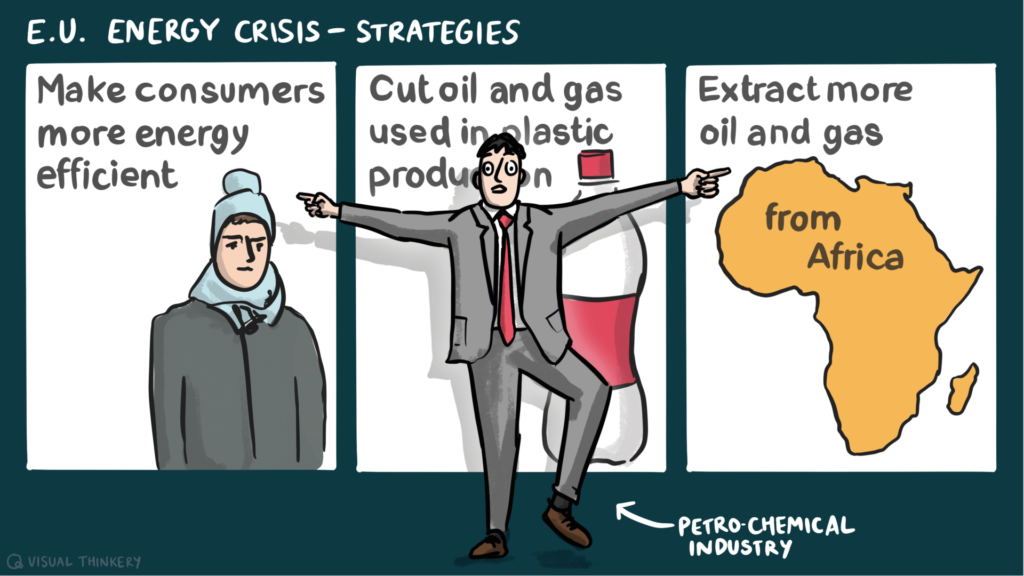
A new report from Break Free From Plastic and CIEL explores the link between the ongoing fuel crisis and the plastics industry.
In 2022, Russia’s invasion of Ukraine unveiled a stark truth: Europe’s heavy reliance on Russian oil and gas. This dependence hit home as energy supplies dwindled and prices surged across the continent. European countries, in particular, were affected, given that Russia supplied 38% of the EU’s gas and 22% of its oil in 2020. By August 2022, it was evident that Europe was in the midst of a severe energy crisis, leading to escalating prices and concerns about heating and power cuts during what might be a bitterly cold winter.
In response to these concerns, the European Union (EU) established an ambitious target for all member countries: reduce energy consumption by 15% before March 31, 2023. Governments started advising consumers on how to save energy, with some suggesting measures like shorter, cooler showers and reducing heating usage. However, it’s puzzling that while citizens are being asked to tighten their belts, industrial use of oil and gas continues unchecked, with no government advice or restrictions.
Now, let’s connect this energy crisis to the world of plastic. The plastics industry is a major consumer of oil and gas in the EU, accounting for 8% and 9% of the EU’s total consumption in 2020. It surpasses industries like steel, automobile manufacturing, machinery, and food and beverages. Astonishingly, over 40% of the plastics produced in the EU’s plastics industry end up as instant waste, primarily single-use plastic packaging.
The EU and its member states have shown leadership in addressing the plastics crisis, with initiatives like the 2018 Plastics Strategy, which aims to transform how plastic products are designed, produced, used, and recycled, a vital part of Europe’s shift toward a circular economy. In 2019, the Single Use Plastics Directive set a target of recycling 90% of single-use plastic bottles by 2029. The EU also played a pivotal role in advancing global efforts to combat plastic pollution at the United Nations Environment Assembly in March 2022.
However, despite these steps to reduce plastic pollution, there has been little talk of putting a cap on the production of unnecessary plastic or restricting the activities of the petrochemical industry. This is perplexing, considering their significant contribution to climate change and the continued depletion of precious oil and gas resources.
The report suggests that reducing plastic packaging by 50% and achieving the 90% recycling goal would save a staggering 6.2 billion cubic meters of fossil gas and 8.7 million tonnes of oil at the EU level compared to 2020. To put that in perspective, these figures are equivalent to the entire oil and gas consumption of the Czech Republic in 2020.
Instead of seeking new trade deals for fossil fuels, this situation presents the EU with a golden opportunity to address the energy, climate, and plastic crisis. Immediate and bold action is needed to cut back on the production of unnecessary plastic by implementing the Plastics Strategy from 2018 and the Single Use Plastics Directive from 2019. This would substantially reduce greenhouse emissions, alleviate plastic pollution, and free up limited energy supplies. The oil and gas earmarked for plastic production could be redirected to provide millions of people with reliable, more affordable energy during the winter. It’s a win-win for the environment and our energy needs.
Read the full report here